Our Second Match
Well, another rather lop-side score, but the games certainly weren’t
lopsided.
Click […] to see list
A terrific performance, I’ve rarely been more proud of a team.
We were giving away nearly 100 grading points over 4 boards, but came out on top without a single loss.
As always, things could have turned out differently, and Sidmouth fought for every square on every board.
{After some vague opening play on both sides, Black dropped an exchange.
After that, White gradually converted but Black had chances to draw (or do
even better) with some little tactics.}
{Some really good attitude by both sides, and some good ideas. White dropped
an exchange and Black had good chances to convert, but White was saved by a
passed g-pawn.}
{A slow game where the centre got blocked, the King’s-side got blocked, and
the players agreed that the Queen’s-side wasn’t worth the effort.}
{White was gradually adding little advantages to his collection but Black’s early grab for space kept it level, then White walked into a tactic, losing the exchange. Black kept control and found a simple breakthrough for a remarkable result.}
The secret of Grandmaster play is to make use of the hidden 65th square on the chess board. I’m sure you’ve all had the experience of having a piece come at you, apparently out of nowhere, to take one of your army. That piece came from the 65th square.
I can’t show you the square, because it’s not on the usual 8×8 grid system, but I can show you that it is there. Watch…
Take a 8×8 chessboard (64 squares, right?), and divide it up in a special way:
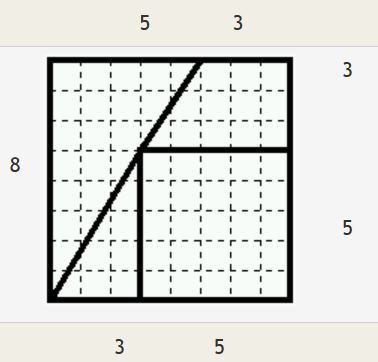
These can be rearranged to make a rectangle.
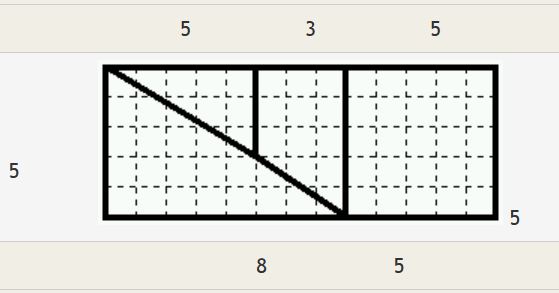
But of course, the 5×13 rectangle has 65 squares. I’m not sure which one is the extra square… but now you know it’s there, you can maybe use it in your games!
(Post inspired by Ivor Annetts, but puzzle devised by Sam Loyd, I believe.)
n the Clubs/Organisations competition as part of the UK Chess Challenge, Exeter Junior Chess Club came out as South-West region winners. Well done to them!
| South West | |||||
| Rank | School | Score | No. of Players | GF Qualifiers | TF Qualifiers |
| 1 | Exeter Junior Chess Club | 21 | 4 | 2 | 1 |
| 2 | Bournemouth Junior Chess Club | 19 | 3 | 2 | 1 |
| 3 | Downend & Fishponds Chess Club | 17.5 | 2 | 2 | 1 |
| 4 | Frome Chess Club | 14 | 2 | 2 | 0 |
| 5 | Musketeers Junior Chess Club | 10 | 2 | 1 | 0 |
| 6 | Pete’s Potentials Chess Club | 8.5 | 1 | 1 | 0 |
| 7 | Wellington Chess Club | 7 | 1 | 1 | 0 |
| 8 | Wotton Hall Chess Club | 7 | 1 | 1 | 0 |
| 9 | Moonrakers Chess club | 6 | 2 | 0 | 0 |
| 10 | Ringwood Chess club | 5.5 | 1 | 1 | 0 |
Ken Bloodworth, who donated the Cup for this junior chess league, died just over a week ago aged 96, playing chess even in his last year. A wonderful man and a player, who did so much for junior chess, not just in Devon but all over Britain.
Obituary at Keverel Chess: http://www.keverelchess.com/ken-bloodworth-1914-2011/
Biography at Keverel Chess: http://www.keverelchess.com/k-j-bloodworth-25-06-1914/
{This back-and-forth game was settling into a tense endgame when White allowed
a snap mate. Both sides allowed and missed chances!}
{Black won a pawn and a piece early on and steered the game to a calm win.}
{ White grabbed a loose piece but lost it back to a neat Black tactic. White came up with a tactic of his own to win the exchange, and swapped off to win.}
{Some loose play by Black gave White a pawn in the opening, and White swapped
his way to the win.}
I’m a bit bored of writing this, but the result doesn’t reflect the closeness of the contests! Great result by Reece, saving us from the whitewash, but some great moves and terrific heart shown by all.
“What’s this piece called?”
“A Bishop.”
“What is it in Spanish, Sophie?”
“Alfil”
“And in French, Agathe?”
“Fou!”
Therein lies a story…
The old Arab form of chess had a piece called the elephant, which, unlike most elephants I know, could jump two squares at a time, diagonally. And ‘al-fil’ means the Elephant in Arabic (Pil in Persian).
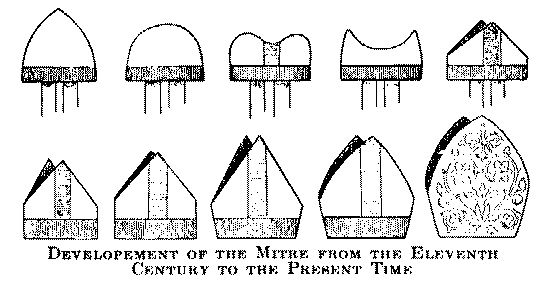
But if you have a lump of stone, or wood, and you want to show that it is an elephant, you might carve two curving lines on it for tusks, or make two points on it to show the same.
And if you then showed it to someone from England, you might hear them say, what’s that, a Bishop’s hat?

https://upload.wikimedia.org/wikipedia/commons/1/17/Mitre_evolution.gif
And if you showed it to someone from France, you might hear them say, what’s that, a hat for a jester, the court fool?
http://a401.idata.over-blog.com/0/26/53/98/logos/eeg.jpg
Here Bruno Fauditti has swapped a jester’s hat for a metal funnel:
https://fr.wikipedia.org/wiki/Temp%C3%AAte_sur_l%27%C3%A9chiquier
Now in modern Western chess, this piece doesn’t hop a little way, it can run right across the board. So the Germans adopted a different name for this piece, Läufer, the runner. There used to be played a version of chess in some parts of Germany which had both the old short-hopping Bishop, and the new long-running Currier, and that variant is called Courier Chess.
http://www.chessvariants.com/historic.dir/courier.html
There is a famous painting of some people playing this game:
https://en.wikipedia.org/wiki/Courier_chess#/media/File:Lucas_van_Leyden…
The Chinese form of chess still keeps the original piece with its original move; in fact, the name of the game, Xiang-Chi, means the Elephant Game.