The secret of Grandmaster play is to make use of the hidden 65th square on the chess board. I’m sure you’ve all had the experience of having a piece come at you, apparently out of nowhere, to take one of your army. That piece came from the 65th square.
I can’t show you the square, because it’s not on the usual 8×8 grid system, but I can show you that it is there. Watch…
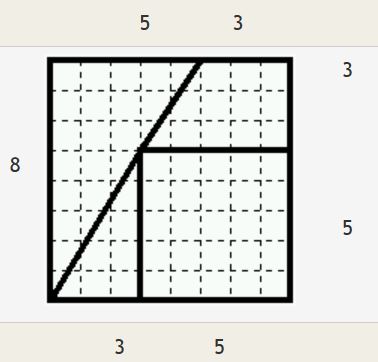
Take a 8×8 chessboard (64 squares, right?), and divide it up in a special way:
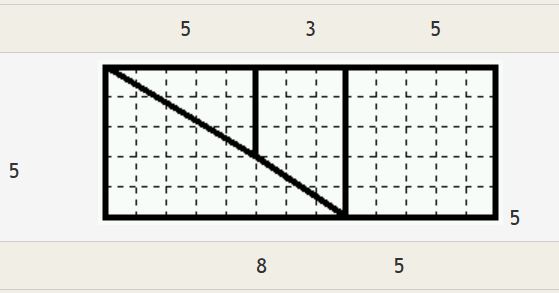
These can be rearranged to make a rectangle.
But of course, the 5×13 rectangle has 65 squares. I’m not sure which one is the extra square… but now you know it’s there, you can maybe use it in your games!
(Post inspired by Ivor Annetts, but puzzle devised by Sam Loyd, I believe.)
We had an unusual game where the Black King charged up the board to e1! This is called a ‘King march’ if the player chooses to do it, or a ‘King hunt’ if the King is chased there.
“What’s this piece called?” “A Bishop.” “What is it in Spanish, Sophie?” “Alfil” “And in French, Agathe?” “Fou!”
Therein lies a story…
The old Arab form of chess had a piece called the elephant, which, unlike most elephants I know, could jump two squares at a time, diagonally. And ‘al-fil’ means the Elephant in Arabic (Pil in Persian).
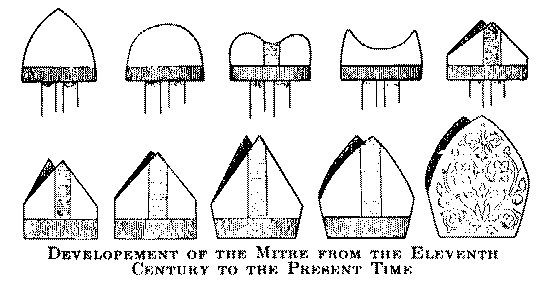
But if you have a lump of stone, or wood, and you want to show that it is an elephant, you might carve two curving lines on it for tusks, or make two points on it to show the same.
And if you then showed it to someone from England, you might hear them say, what’s that, a Bishop’s hat?
Now in modern Western chess, this piece doesn’t hop a little way, it can run right across the board. So the Germans adopted a different name for this piece, Läufer, the runner. There used to be played a version of chess in some parts of Germany which had both the old short-hopping Bishop, and the new long-running Currier, and that variant is called Courier Chess.
Last week the juniors saw the game of Shogi played. It’s the sort of chess played in Japan, and by our new friends Kaz and Hatzune. How is Shogi related to the sort of chess that we normally play?
When I first looked at the history of Western Chess, I thought that the original game was Chaturanga, a game played in India before 600AD. Chess as played in other countries seems to come from the Arab form of Chess called Shatranj. And that is what I used to tell people.
Chaturanga --> Shatranj --> Medieval chess --> Modern Western chess
                        ---------------------> Chinese Chess (Xiang-Chi)
                        ---------------------> Japanese Chess (Shogi)
But I now believe that the best picture that fits what we know says that Chaturanga and Shatranj were both later forms of an original game, which we don’t know much about.
Sort-of-Chess --> Chaturanga
              --> Shatranj --> Medieval chess --> Modern Western chess
                           ---------------------> Chinese Chess (Xiang-Chi)
                           ---------------------> Japanese Chess (Shogi)
There are lots of different sorts of chess around the world that seem to come from the same stock, including:
Each form of chess seems to have its own special rule that makes the game come alive. Burmese chess is the only sort of chess where you can decide where to put your pieces at the start of the game; Japanese chess is the only sort of chess that uses the ‘drops’ that we see in Exchange Chess; Chinese Chess is the only sort of chess that has the Cannon piece; modern Western Chess is the only sort of chess that has the super-duper Queen. (In fact, our game used to be called le Jeu de la Dame enragée — the game with the Mad Queen.)