
Chess Notation
To read about chess and be able to analyse games to improve, you need to know the special notation that is used.
If you know the basic idea but are slow, you can practice on Lichess - how fast can you go?! (If you have an account, it will chart your progress.)
If you are unsure about chess notation, then here is a guide . . .
The pieces are given a single, large, letter abbreviation as follows: -
- K for King
- Q for Queen
- R for Rook / Castle
- B for Bishop
- N for Knight, because K has already been used for the King
- pawns are not considered to be pieces and have no abbreviation!
Often, in print or on screen, the little pictures that represent the pieces on a chess board (figurines) are used instead of letters
This board has been copied from Wikipedia.
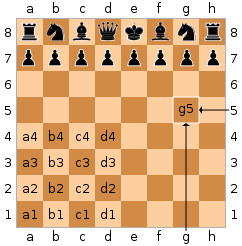
- Each column (file) is given a letter from a to h, starting on White's left.
- Each row (rank) is given a number from 1 to 8, starting on White's side.
- Looking at the square labelled g5, the arrows show that it is in column g and row 5.
- The labels for the 16 squares in the bottom left corner are shown.
- Each of the 64 squares on the board has a unique label.
For beginners, the long notation for a move uses the letter for the piece; starting square; a dash; finishing square. For example, Ng8-f6 which means the Knight on g8 moves to f6. For a pawn move, no piece label is given. So, e7-e5 means the pawn on e7 moves to e5. For captures, the dash is replaced by a small x (multiplication sign). So, in the middle of a game, Qb3xh3 means the Q on b3 capture whichever pawn or piece is on h3.
Books and websites use a short notation. This does not give the starting square or use a dash. The three moves above would become Nf6, e5 and Qxh3 (or maybe just Qh3, though it is clearer to use a 'x'). This short notation is easy to read once you get used to it, but it has a problem if two identical pieces can both move to the same square. For example, looking at the board above, image that there is a Knight on b1 and another on a4. They can both move to c3. In long notation these moves would be Nb1-c3 and Na4-c3. In short notation just the rank or file is added, so these become (N1c3 or Nbc3) and (N4c3 or Nac3). If you are recording your own game, the long and clear notation is fine. Another quirk of the short notation is for pawn captures. exd (or just ed) means the pawn on the e file captures the pawn on the d file, and the ranks would be obvious from the position.
There are also some special notations.
- O-O means castle on the King's side
- O-O-O means castle on the Queen's side
- = is used for pawn promotion. For example e8=Q (or e8Q) means the pawn on e7 moves to e8 and promotes to a Queen
- e.p. means an 'en passant' pawn capture has been made (not likely for beginners)
- + means check
- ++ or # mean checkmate
- 1 - 0 means White has won
- 0 - 1 means Black has won
- 1/2 - 1/2 means a draw
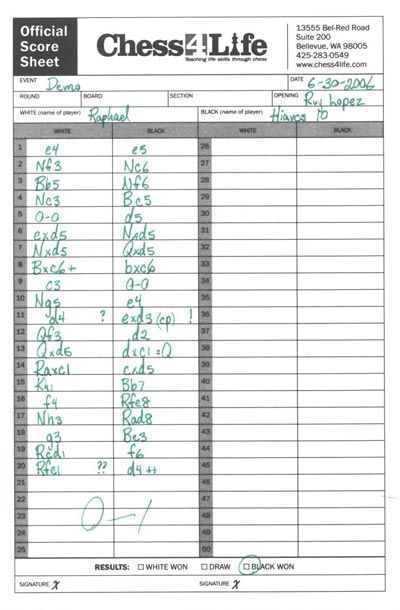
In a tournament, the games must be recorded accurately. This requirement is sometimes relaxed for junior tournaments. Here is an example scoresheet . . .
A fuller guide to chess notation can be found in this Wikipedia article.